Hume, The Great Disentangler (ft. Descartes)
Science, religion, and philosophy, despite their differences, share their origins in one question — what is the nature of reality? We first developed gods (and later God) and codified religions to make sense of the world around us. Introspection on religion led to the development of philosophy and, eventually, to the creation of science. Now, in the modern day, religion is separately studied and analyzed from the majority of science and philosophy, despite sharing the same origins and analyzing the same questions. Although there are a myriad of reasons for this detachment, we can trace the origins of the split back to an ambitious Scottish philosopher named David Hume.
Before we tackle what Hume did, let’s set the stage of the 18th century and see the state of science, religion, and philosophy. Religion still reigned as the supreme focus of intellectual activities, and most of philosophy was devoted to studying (and validating) religion. Science, for the most part, was still in its infancy; it was mostly seen as a branch of philosophy.
The quintessential example of a pre-Hume philosopher was Rene Descartes. Now, Descartes was both a firm believer in the Catholic Church and a deeply inquisitive person, and his philosophy was reflective of both of these aspects. In both Discourse on the Method and Meditations on First Philosophy, Descartes asked how we can trust anything at all if our senses and minds are fallible. In fact, how do we even know that we exist? Stumped, Descartes kept hacking away at his own beliefs and perceptions until he arrived at his most famous conclusion: cogito ergo sum (I think, therefore, I am). (Fun fact: the line “Cogito ergo sum” came from Discourse and not Meditations, which was surprising to me when I read both considering Meditations is arguably more famous).

At this point, Descartes was faced with a problem. He was able to prove that he exists, but he’s not able to go farther than that. In fact, he found a more concerning problem: what if all of his senses are being deceived by an “evil demon”? This is where Descartes was “forced” to loop in God to his philosophy. He knew that he is fundamentally an imperfect being; however, he is able to understand the concept of a higher, more perfect being. He reasoned that the idea of a more perfect being must originate from a higher power, because he could not uniquely originate that idea himself (as he is an imperfect being). Therefore, God must exist. Descartes also found, after some deliberation regarding God’s veracity, that God’s existence guarantees that there is an external reality and that for the most part, what he observes in the world around him is true. Descartes also championed rationalism, doing philosophy and science through reasoning alone. He frequently retreated inwards and derived thought experiments to show the validity of his arguments rather than more empirical arguments. This is best exemplified by his mind-body dualism, where Descartes literally separates the body from the mind, appearing to reject empiricism and experimentation altogether.
God is fundamental to Descartes’s philosophy, and he uses this to justify his belief in the Catholic Church. A small side tangent worth noting is that Descartes was acutely aware of what the Church did to Galileo (which he mentions in Discourse) and dedicated Meditations to the clergy. Some scholars debate whether his introduction of God in his philosophy was truly his own belief or also for his benefit to avoid the same fate as Galileo. Keep in mind, the Catholic Church was the most powerful institution in the world at the time, so having the backing of the Church almost gives his ideas doctrine-level protection. But regardless of other motives, Descartes’s philosophy is directly intertwined with religion and relies heavily on rationalism.
Enter David Hume. Hume was a few generations removed from Descartes; as a result, Descartes’s ideas have had time to develop and mature by the time Hume entered philosophy. An important thing to note is that Hume was in the middle of the Age of Enlightenment, when philosophy and science were starting to diverge from religion. With the new times, the fear that prior thinkers had to state their beliefs that contradicted the church was diminishing. Hume was able to capitalize on that trend of waning fear when he began writing An Enquiry Concerning Human Understanding. Hume was motivated to write his Enquiry (and the rest of his works) to strip philosophy of its more abstract, impractical aspects and cut down to the direct essence of philosophy. He began by attempting to understand the principles of human thought, arguing that if we understand how we perceive information, we can combat erroneous arguments with more conviction. After some reflection, Hume found that humans understand the world around us through cause and effect.
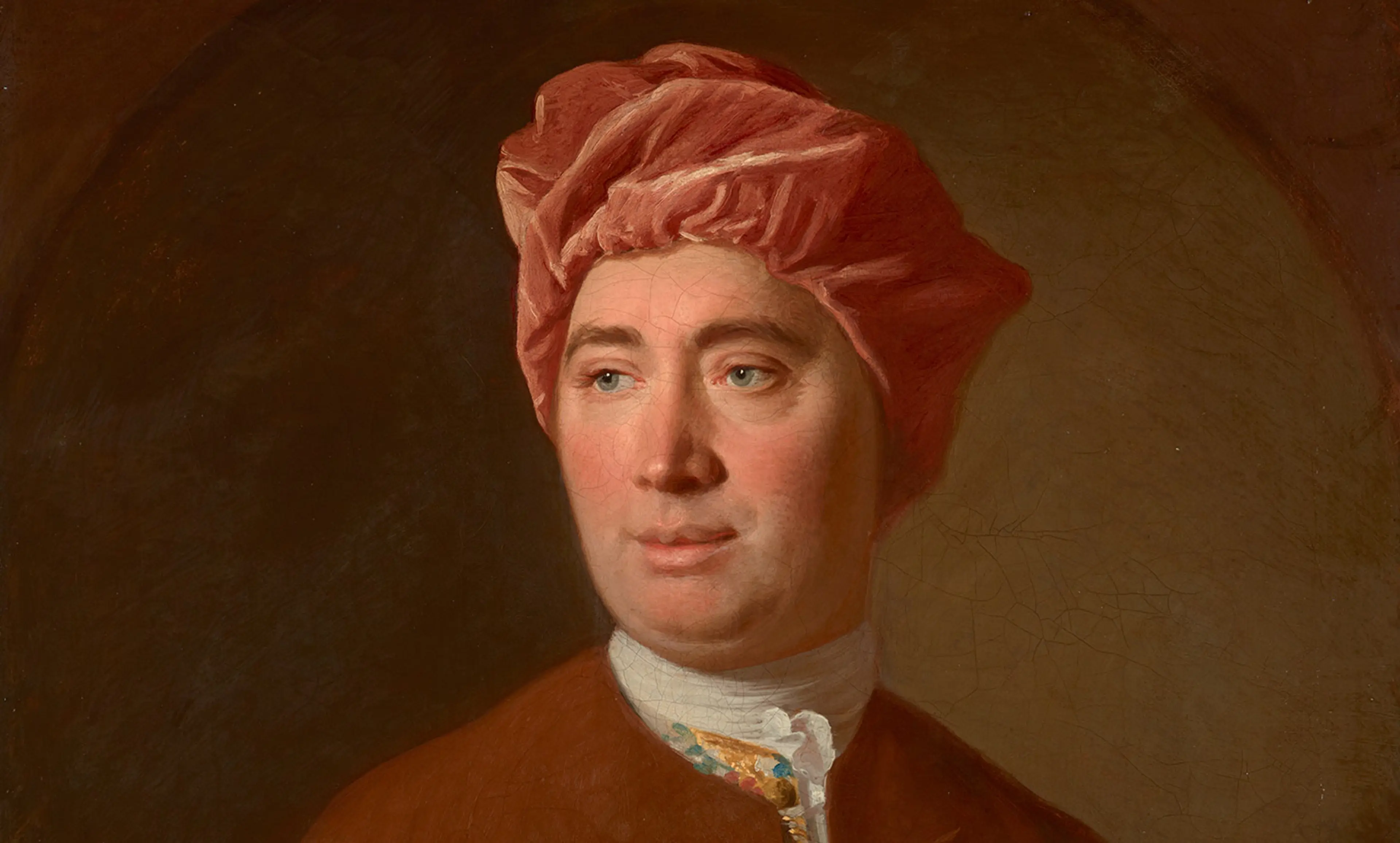
Empiricism is central to Hume’s ideas about human knowledge. We learn not through reasoning and logic but through experience. Hume uses the example of a man who has a rational brain but no experience (a “rational” Adam). If he sees billiard balls for the first time, he will not know that when he moves the first ball, the second one that it collides with will move as well. Only after repeatedly observing dozens of pool games will the man begin to understand the mechanics of the game. This empirical philosophy is nearly identical in spirit to the emerging scientific method of the era: Francis Bacon had already argued decades earlier that knowledge should be built from repeated observation rather than first principles. However, Hume also identified a major issue with this line of reasoning: there’s nothing that guarantees us causality. We simply inherit causality as an instinct, we cannot use reason to conclude that causality is real. To assume causality is real via experience, we would be assuming that because nature has been uniform in the past, it must be uniform in the future. But this inference assumes the uniformity of nature, the same thing we’re trying to prove. The circular reasoning leads to what is now called the problem of induction. Hume validates philosophically that science works, but is unable to show WHY it works at a deeper level. This is still a long-standing problem in philosophy, and Hume is pretty humble about not being able to solve it. He simply defers the problem by saying that we inherit causality through habit and instinct.
After establishing his brand of empiricism, Hume went after religious doctrine. Many religious traditions and doctrines are built on the assumption that God exists and that God performs miracles. Miracles, by definition, are breaks from the laws of nature. However, our entire lives are conditioned to solely accept the laws of nature as fundamental. We are only able to progress our knowledge (scientifically and personally) through repeated observation and experimentation, not through one-off miracles. After this conclusion, Hume argued that miracles were more likely to be caused by lack of credible sources instead of the laws of nature bending. Hume was careful not to deny the existence of miracles (that would have gotten him in trouble with the Church), but he simply points out the ridiculousness of many miraculous events. By showing the rational impossibilities of miracles, Hume takes out a pillar of religion in the process. This demonstration is a sharp inversion of Descartes, who used his philosophy to prove that God and miracles are possible.
But Hume isn’t done here; he took direct shots at Descartes’s philosophy of rationality at the end of his Enquiry. First, he calls out Descartes for shoehorning in God to solve the problem of uncertainty (also called the Cartesian circle fallacy) in a brief paragraph. He then went on to demonstrate why Descartes’s rationality fails through the example of infinite divisibility. Descartes had established that space must be infinitely divisible because we can always conceive of dividing a line further, no matter how small. Hume pointed out that this conclusion contradicts itself once you actually try to picture it. The idea of infinite divisibility taken at face value implies that a grain of sand is the same size as the earth, since both are infinitely divisible. The idea of infinite divisibility isn’t something we can actually derive from experience or imagination at all; it’s reason detached from any experiential anchor, which Hume claims is the primary failure of Descartes’s rationality. Rationalism lets us construct arguments that are internally consistent but have no real claim on truth, because they were never checked against anything but themselves.
In his Enquiry Concerning Human Understanding, Hume disentangled science, philosophy, and religion. He was able to build a new philosophical framework to understand the world around us that is distinct from any prior, preconceived notions. He presents a more modest skepticism, one that strives for simplicity and clarity instead of being bogged down in nonsensical metaphysical debates. Once Hume was able to build a philosophy that is independent of religion, religion no longer had to be a loadbearer for science and philosophy; they could evolve separately into their modern-day forms. We started this whole journey by asking what the true nature of reality is. Hume says that we don’t actually know at the current moment, but that’s fine. According to Hume, the only way that we can further our understanding of reality is through empiricism and experimentation, not through reason alone. Although the problem of induction still looms over Hume’s philosophy, we can clearly see that his philosophy has held up the test of the modern day. We’ve built our schools and learning platforms around Hume’s empirical learning principle (learning via repeated observation), and Hume continues to live on through AI. We train our neural networks by following Hume’s framework of learning through repeated observation, giving us unprecedented technological breakthroughs. Hume’s insight will continue to be useful as long as we keep on experimenting, giving us a philosophical grounding for our curiosity and scientific inquiry. We truly live in a post-Hume world.